Review Wednesday: The End of Oak Street
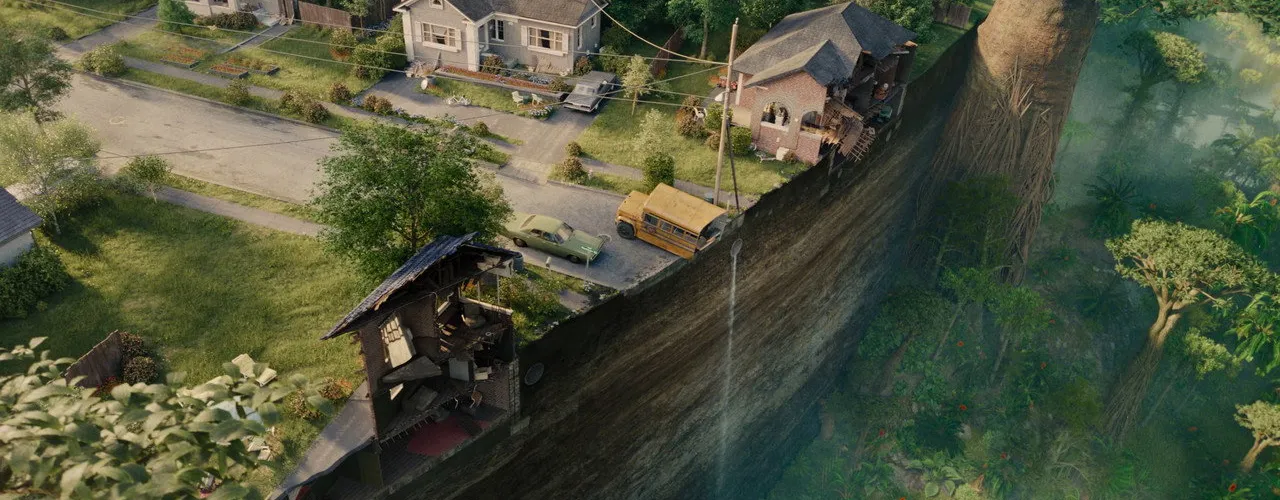
The End of Oak Street has a premise that reads like a pitch meeting nobody stopped in time: a cosmic event picks up an ordinary suburban street, people and pets and lawns and recycling bins included, and sets it down in the distant past, leaving the residents to slowly discover what’s happened as prehistoric life encroaches on their peaceful existence. I bought a ticket expecting dumb fun. I like dumb fun. I had already forgiven the movie for being dumb fun on the way in.
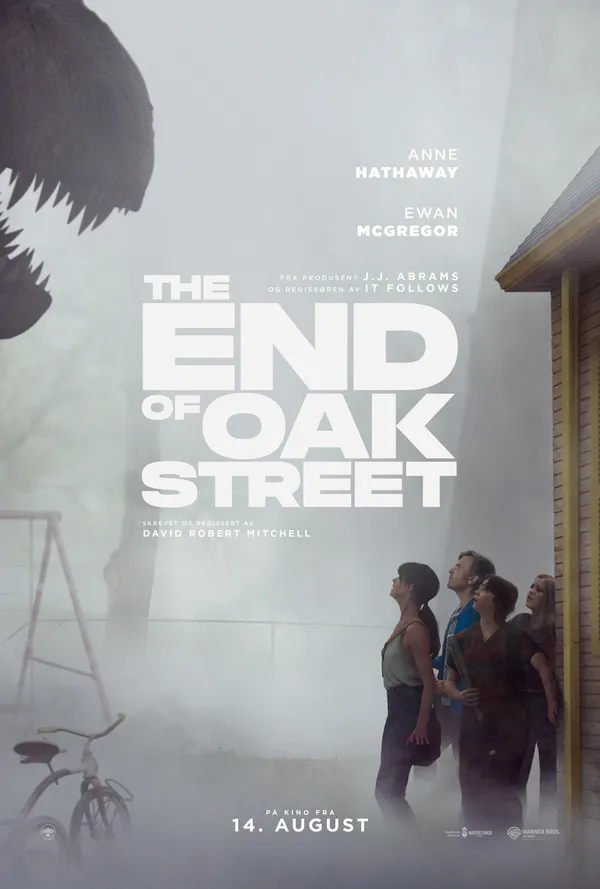
The thing that got me is that it is an Amblin movie. Not Amblin-referencing, not Amblin-quoting, not a poster of E.T. hung on the wall of a movie that has nothing else to say. The actual grammar of one. The kids are people rather than plot devices with bikes. The adults are competent (well, the ones who need to be are…) and still out of their depth, which is a daring line to walk. And the spectacle is dramatic with a real sense of danger, but it doesn’t become just a torrent of action that’s impossible to follow. Altogether, it is an updated twist to the pattern that Jurassic Park so perfectly established and the sequels have mostly failed to reach.
The Jurassic Park comparison is the one I kept coming back to, and I mean it structurally rather than as a compliment I am handing out for free. Awe first, teeth second. The movie gives you a chance to really look at the creatures before you have to confront how deadly they are, and it trusts a wide shot to do the work. There are rules to the danger, the movie establishes them early, and then it honors them, so when someone does something stupid you get to be ahead of the movie for a second, which is a lot of the fun of this kind of film.
Some of that credit goes where you would not expect it from the trailer. David Robert Mitchell directed this, and if your reference point for him is It Follows, you can feel the same patience here: long, unhurried compositions where the frame itself is the thing making you nervous. In some ways this seems like a departure for him, but stepping back you can see a lot of shared vision among all of his last three films. J.J. Abrams produced, which makes perfect sense of the Amblin vibes given his history with Spielberg and the explicit homage to the Amblin style in Super 8. In fact, End of Oak Street really feels like a spiritual successor to Super 8. They would make for a great double-feature.
The element that really stands out is how the relationships of everyone in the film are treated. Denise and Greg Platt (Anne Hathaway and Ewan McGregor) have a complex, realistic relationship that is brought to life both subtly and explicitly, which gives it real depth. It’s explicit in Greg’s inability to deal with what’s happening to him and his family, both before and after the event, and the frustration that Hathaway deftly brings to Denise in the face of it. The additional texture that comes through in microexpressions, inference, and set dressing more subtly elevates the movie to something noteworthy when it could have just been “fine.” All the characters feel like they have an actual life that is happening off-screen, even the jackass neighbor Mel (P.J. Byrne) and the whole host of kids who make appearances, not just the two Platt kids, Audrey and Brian (Maisy Stella and Christian Convery).
Which brings me to the sequence everyone is going to be talking about, but it’s up to you to decide if you want to read about it. Big spoilers after the click.
Greg Platt gets eaten. Not off-screen, not ambiguously, not in the way where you assume he is dead until he limps back in the third act. He is eaten, in the middle of the movie, while doing the brave and heroic (but stupid) thing, and the film does not soften it afterward.
It works because of everything the movie spent its first hour building. He is the adult who has been in denial about everything the whole way through, so losing him is not just a death, it is the movie taking away the audience’s handrail. The seemingly inevitable redemption arc for him and Denise is abruptly and brutally cut short. Suddenly, it seems like all the conventions of “this kind of movie” are out the window, which makes the remaining screentime even more tense. The scene is also staged with the same clarity as everything else, which somehow makes it worse. You can see it coming for about four full seconds and there is nothing to do about it but sit there.
The moment that really stuck with me, that I have not stopped thinking about, is the cut immediately after, where Denise stands there in shock and horror, her face a mirror of my own, for far longer than was really necessary. Denise has proven herself to be the real adult in the family, though, and she soon pulls herself together and does the right thing. That is a real choice, and a braver one than the death itself.
I was a little disappointed that they found a way to bring him back in the end, but it felt earned even if a little saccharine.
So: a strong recommend, and worth the theater, which is not something I say often. Go before the internet gets to you. The film’s whole first act works on the assumption that you do not know what is coming either, and that only happens once.